Why We Built a Travel App for Our Clients and Why It's Now Available to Everyone

There is a particular kind of chaos that travelers know well. It shows up in airport terminals when you are scrolling through three different email threads trying to find a confirmation number. It appears at hotel front desks when the reservation is under a different name than you expected and you cannot remember which email has the details. It surfaces on the morning of a cruise departure when someone in your group asks what time boarding starts and nobody is entirely sure where that information lives.
This is not the chaos of spontaneous adventure or the beautiful unpredictability of discovering a new place. This is administrative friction. The kind that takes you out of the moment and forces you to become a part-time data analyst when you should be enjoying your trip.
We have watched this happen for years. As travel advisors, we spend significant time organizing trip details for our clients, creating clean itineraries, tracking confirmations, and making sure everything is accessible when needed. Behind the scenes, we have systems that keep all of this information organized. Flight times, hotel addresses, excursion schedules, document requirements. Everything in one place, easy to reference, easy to update when things change.
But our clients did not have that same visibility. They had email inboxes. Screenshots. Notes apps. Browser bookmarks. Group text threads with partial information. The gap between how we manage travel behind the scenes and how travelers actually experience their trip logistics was real and often frustrating.
That gap is why we built the Travel by Trinidad app. And today, it is officially available in the App Store.
The Problem We Kept Seeing
Travel involves a surprising amount of information. A single trip might include flight confirmations, seat assignments, hotel bookings, rental car reservations, cruise documents, excursion tickets, restaurant reservations, and travel insurance details. Each of these comes from a different source, arrives at a different time, and lives in a different place.
Airlines have their own apps. Hotels have their own apps. Cruise lines have their own apps. Rental car companies have their own apps. Each one wants you to create an account, remember a password, and check their specific platform for updates about their specific slice of your trip.
For a simple weekend getaway, this is manageable. For a two-week Mediterranean cruise with pre-cruise hotel stays, post-cruise flights, and shore excursions booked through three different vendors, it becomes genuinely difficult.
We started noticing patterns in the questions clients asked us. Not questions about destinations or experiences, but logistical questions that should have been simple to answer. What time does our flight leave? Which terminal? What is the address of the hotel? When does the shuttle pick us up?
These were not failures of planning. These were failures of access. The information existed. It was just scattered across too many places for anyone to find it quickly.
How Advisors See Trips Versus How Travelers Experience Them
When we plan a trip for a client, we build a complete picture. Every confirmation, every detail, every document goes into a system that lets us see the full itinerary at a glance. If a flight gets rescheduled, we know. If a hotel sends updated check-in instructions, we capture it. If an excursion time changes, we adjust accordingly.
This comprehensive view is essential for doing our job well. It lets us spot potential issues before they become problems. It allows us to make recommendations that account for transit times and logistics. It gives us the context we need to help when something goes wrong.
But for a long time, our clients experienced their trips very differently. They received the same confirmations we did, but without the organizational layer that made sense of it all. They had the pieces but not the puzzle completed.
The app exists to close that gap. To give travelers the same clear, organized view of their trips that we have when we are planning them.
Built Around the Trip, Not the Supplier
Most travel apps are built to serve one company’s bookings. The airline app shows your flights. The hotel app shows your reservations. The cruise app shows your ship’s itinerary. Each one is useful in isolation but none of them understands your trip as a complete experience.
We approached this differently. The app is organized around your trip as a whole, not around individual suppliers or booking sources. Everything related to one journey lives together, in chronological order, with the context you actually need.
When you are standing in an airport wondering which gate to find, you do not care which vendor’s system originally generated your boarding pass. You care about getting where you need to go. The app is designed with that reality in mind.
This might sound simple, but it represents a fundamentally different philosophy than most travel technology. We are not trying to drive bookings or promote particular suppliers. We are trying to reduce the cognitive load of travel. Fewer apps. Fewer logins. Fewer moments of uncertainty about where information lives.
From Email Chaos to Organized Itinerary
One of the most common sources of trip information is email. Booking confirmations, itinerary updates, travel documents. They arrive over weeks or months, often out of order, sometimes with conflicting information as plans change.
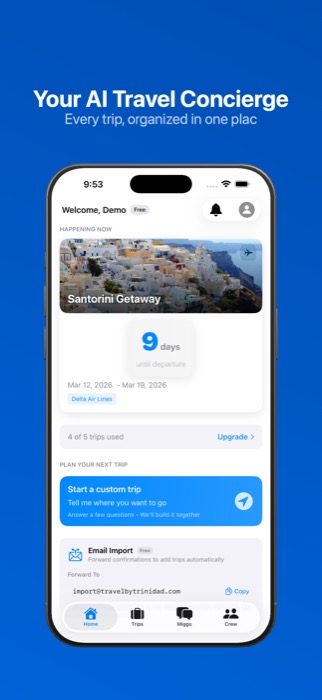
The app addresses this directly. Forward your confirmation emails to a dedicated address and the system extracts the relevant details automatically. Flight numbers, times, confirmation codes, addresses. The information gets organized into your trip timeline without requiring manual data entry.
This is not about replacing your email inbox entirely. It is about creating a clean, organized layer on top of the chaos. The original emails still exist for reference. The app provides a curated view of what actually matters when you are traveling.
For families planning trips together, this becomes even more valuable. One person handles the booking. Others forward their confirmation emails. Everyone ends up with the same organized view of what is happening and when.
Handling Changes, Not Just Perfect Plans
Travel plans change. Flights get rescheduled. Hotels modify check-in times. Excursions get moved or canceled. A travel tool that only works when everything goes according to plan is not particularly useful.
We built the app to handle reality, not just idealized itineraries. When something changes, the app can surface updates so you are not caught off guard at the airport. The goal is not to pretend that travel is predictable but to give you clear visibility when it is not.
This matters especially for complex trips. A two-week cruise with flights, hotel stays, transfers, and shore excursions involves dozens of individual components. Any one of them can change. Having a single place where those changes become visible reduces the mental overhead of keeping everything straight.
Families and Groups
Travel rarely happens alone. Families plan together. Friend groups coordinate logistics. Wedding parties book rooms and flights over months of planning. Multigenerational trips involve grandparents, parents, and children with different schedules and different needs.
Group travel multiplies the organizational complexity. Information gets shared in fragments. One person has the flight details. Another has the hotel confirmation. Someone else booked the rental car and nobody remembers which email address they used.
The app supports this reality. Shared trips let multiple people see the same itinerary. Updates made by one person become visible to others. The grandmother who wants to know when the cruise departs can see the same timeline as the adult child who made the booking.
This is not about giving everyone editing access to change plans. It is about giving everyone visibility into what the plans actually are. Less texting to ask basic questions. Fewer confused conversations at the airport about which airline someone is flying.
When Advisors Need Context
One of the more subtle benefits of centralized trip information is what happens when something goes wrong. A flight gets canceled. A hotel cannot find a reservation. A cruise departure gets delayed and everyone’s transfer schedule falls apart.
In these moments, travelers call their advisor. And the first several minutes of that call are often spent trying to understand the situation. Which flight? Which confirmation number? Who is traveling? What were the connecting arrangements?
The app gives us context faster. When a client reaches out, we can see what they see. We understand their situation immediately instead of reconstructing it from scattered information. This lets us move directly to solving the problem instead of spending precious time gathering basic facts.
For travelers, this means faster help when help is needed. For us as advisors, it means better service with less frustration on both sides.
Quiet When Smooth, Present When Needed
Good technology often disappears into the background. You do not think about it when everything is working. You only notice it when you need it and it is there.
We designed the app with this principle in mind. It is not trying to engage you constantly or send notifications about things that do not matter. It is not gamifying your travel planning or creating artificial urgency about deals you might miss.
When your trip is going smoothly, the app is simply there with your information organized and accessible. When something changes or you need to reference a detail, the information is ready.
This might sound like a modest goal compared to apps promising to revolutionize how you travel. But we think there is value in tools that do their job without demanding attention. Travel has enough distractions. The app does not need to be another one.
What the App Provides Today
At launch, the app delivers core functionality that addresses the problems we have seen most consistently:
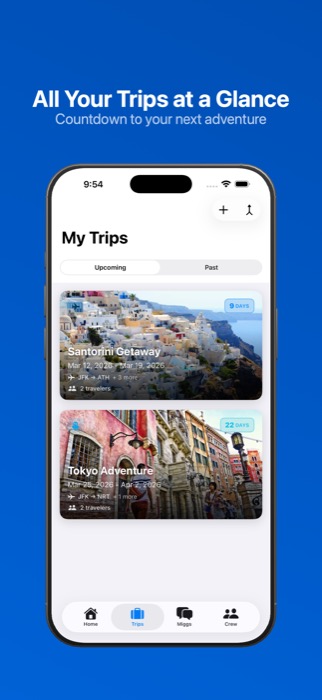
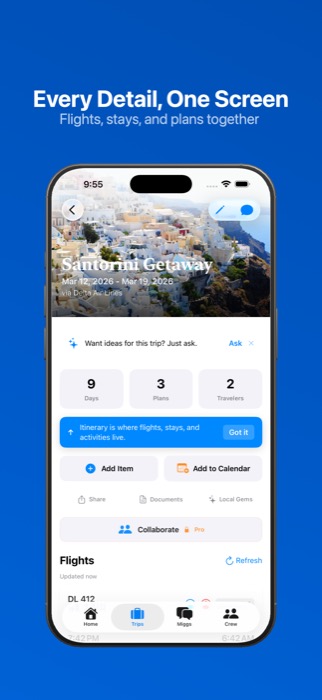
Centralized trip itineraries that bring all your bookings into one timeline. Flights, hotels, cruises, rental cars, excursions, restaurants. Everything for a trip lives together.
Automatic organization from forwarded confirmation emails. Send your booking confirmations to a dedicated address and the app extracts the relevant details into your itinerary.
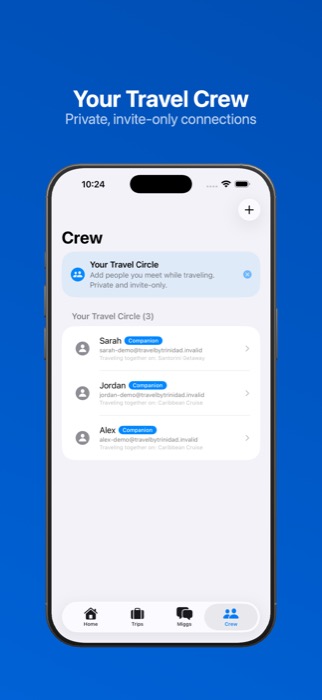
Shared trips that let families and groups see the same information. Add travel companions and everyone gets visibility into the plans.
Important dates and deadlines that help you track what is coming. Final payment dates, check-in windows, document requirements.
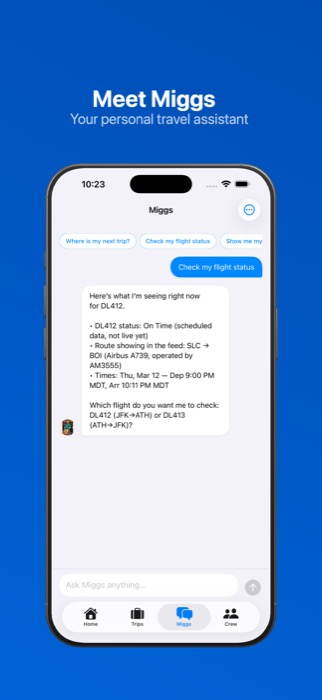
Updates when schedules change, so you are not surprised by a shifted departure time or modified gate assignment.
Clear visibility for both travelers and their advisors. When you work with Travel by Trinidad, we see what you see and can help more effectively.
These are not theoretical features for hypothetical travelers. They are solutions to specific problems we have encountered repeatedly over years of helping people plan and manage their trips.
What the App Is Not
It is worth being clear about what the app does not do, because travel technology often promises transformation and delivers frustration.
The app is not a booking engine. It does not search for flights or compare hotel prices. It does not offer deals or suggest alternatives to what you have already planned. Building and curating a trip is what advisors do. The app is about managing and accessing that trip, not replacing the planning process.
The app is not trying to automate away human judgment. Complex travel decisions benefit from experience, context, and relationships that algorithms cannot replicate. A family asking whether they should extend a layover to explore a city or push through to their destination needs advice from someone who understands their preferences and constraints. The app does not pretend to provide that.
The app is not about removing advisors from the equation. It is about making the collaboration between travelers and advisors more effective by ensuring everyone has access to the same organized information.
Clients Get Full Access
If you book travel through Travel by Trinidad, the app is part of your experience. No additional cost. No premium tier to unlock features. No upsells for functionality that should have been included from the start.
This is straightforward. The app exists to serve our clients better. Charging extra for tools that make the service work smoothly would undermine the point. When you work with us, you get access to everything the app offers.
This alignment matters. We are not building a technology business that happens to offer travel advice. We are a travel agency that uses technology to deliver better service. The app supports that service. It does not exist as a separate profit center.
Why the App Is Available to Everyone
We could have limited the app to our booking clients only. That would have been simpler in some ways. Smaller user base, fewer support questions, more controlled experience.
But the problem the app addresses exists beyond Travel by Trinidad bookings. Independent travelers face the same fragmentation. People who book their own flights and hotels still deal with scattered confirmations and disorganized trip information. The chaos is universal even if the solution has been limited.
Making the app available to the general public reflects a belief that the tool has real value even without a booking relationship. If you travel at all, you probably have emails scattered across your inbox and screenshots saved to your camera roll. The app helps with that regardless of how you booked.
For some users, the app might be their first interaction with Travel by Trinidad. They download it, organize a trip, and realize the value of having someone who actually thinks about travel logistics for a living. That is a natural outcome, but it is not the primary goal.
The primary goal is building something genuinely useful. If the app helps people travel more easily, that is worthwhile whether or not they ever become clients.
Why This Matters Right Now
Travel has grown more complicated over the past several years. Policies shift. Schedules change with less notice than they used to. Airlines restructure routes. Hotels adjust procedures. Cruise lines modify embarkation processes.
Keeping track of all of this is harder than it was a decade ago. The window for showing up at the airport and figuring things out has narrowed. Travelers who stay organized and informed have meaningfully better experiences than those who do not.
Centralized trip visibility is no longer a nice-to-have. It has become closer to essential for anyone taking trips that involve more than a single flight and a single hotel. The complexity will not reverse itself. Better tools are necessary.
App Store Approval
Getting approved for the App Store is a milestone worth acknowledging. Apple reviews apps carefully and rejects many that do not meet their standards for quality, privacy, and user experience. Passing that review represents external validation that the app is built correctly.
This is not the finish line. It is a starting point. The app will continue to improve based on how people actually use it and what friction points emerge. But meeting the standards required for public distribution means the foundation is solid.
We approached this carefully and conservatively. No rushing to market with half-built features. No promises about functionality that does not exist yet. The app available today does what we say it does, reliably and consistently.
What Comes Next
The app will continue to evolve. Features will be refined based on real usage patterns. Functionality will deepen in areas where travelers encounter the most friction. Integration with concierge workflows will become tighter as we learn more about how clients use the tool alongside our services.
We are not publishing a roadmap or making promises about specific features coming in specific timeframes. That kind of speculation often leads to disappointment when reality diverges from plans.
What we can say is that development will be driven by actual needs rather than theoretical possibilities. If clients consistently encounter a problem that the app could solve, that becomes a priority. If a feature sounds impressive but nobody actually needs it, that does not.
The goal is utility, not feature count. An app that does ten things exceptionally well serves travelers better than one that does fifty things adequately.
A Tool That Reflects How We Work
Travel by Trinidad has always been about thoughtful service. Taking time to understand what travelers actually want. Paying attention to details that make trips smoother. Being available when things go wrong and knowing enough about the situation to help effectively.
The app is an extension of that philosophy. It embodies the same attention to organization and clarity that we bring to planning trips. It gives travelers access to the same organized view of their journeys that we use when advising them.
Technology should support human service, not replace it. The app exists to make collaboration between travelers and advisors more seamless. To reduce the friction of accessing information. To create space for enjoying the trip instead of administering it.
For Travelers Ready to Explore
If you are curious about the app, it is available now. No pressure to download immediately. No countdown timer creating artificial urgency.
Take a look when the timing feels right. If your email inbox is full of scattered booking confirmations and you would rather have them organized, the app might be useful. If your next family trip involves coordinating information across multiple people, the shared itinerary feature might save some frustration.
And if you are already a Travel by Trinidad client, the app is simply another part of the experience. A way to access your trip details easily and stay connected with us when you need assistance.
Closing Thoughts
Building this app took longer than expected. There were countless decisions about what to include and what to leave out. Questions about how much technology should try to do versus how much should remain in human hands. Debates about features that sounded useful in theory but would add complexity without adding value.
The result is intentionally focused. An app that does a specific thing well rather than attempting to solve every problem in travel. A tool that respects the reality of how people actually travel instead of imposing an idealized workflow.
Travel is one of the best things people do with their time and resources. Seeing new places. Sharing experiences with family. Celebrating milestones in beautiful locations. The logistics should support those experiences, not detract from them.
The app is our contribution to making that possible. One organized itinerary at a time.